
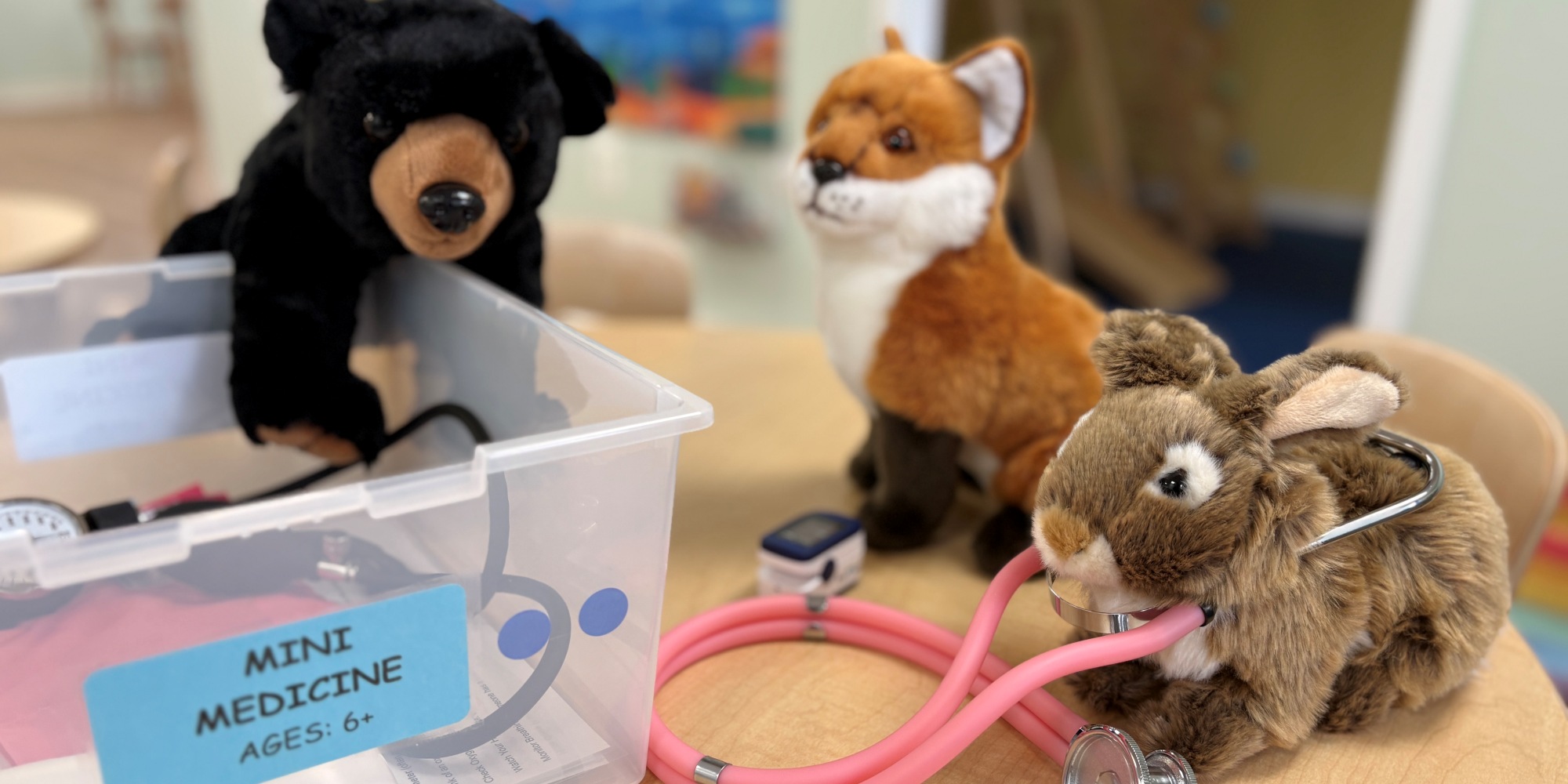
Play is often described as what children do when learning stops. The research tells a different story. For young children, play — especially purposeful, thoughtfully designed play — is the learning. Every time a child builds a tower, negotiates a role in pretend play, or works through a puzzle, they are developing the cognitive, social, emotional, and physical foundations that support everything that comes next.
What Is Play With Purpose?
Not all play looks the same, and that’s a good thing. Free, unstructured play has real value. But purposeful play, in environments and materials intentionally chosen to support a child’s development, can feel completely natural and joyful to a child while quietly doing important work. When an environment is designed well, children don’t know they’re “learning.” They’re just playing, as they normally would.
What Children Build Through Play
- Thinking and problem-solving. Play builds executive functioning, the mental toolkit that includes working memory, flexible thinking, and self-regulation. These skills are foundational for academic success and for navigating everyday life.
- Language and communication. Children expand vocabulary and practice expressing ideas in real time. Research from the American Academy of Pediatrics confirms that children learn language most effectively through interactive, playful experiences.
- Social and emotional growth. Play is where children learn to cooperate, take turns, manage frustration, and build friendships. Imaginative play in particular helps children process emotions and develop empathy.
- Physical development. From climbing and balancing to drawing and building, movement-rich play strengthens the body–brain connection and builds the confidence that keeps children engaged and active.
- Creativity and resilience. Open-ended play, where there is no single right answer, teaches children to take risks, try new ideas, and recover when something doesn’t go as planned. These are the seeds of a growth mindset that carries well beyond childhood.
The Value of Playing Across Ages
Most of the time, at school, in organized sports, in structured classes, children spend their time with peers born within months of them. Community play spaces offer something different: the chance to interact across age groups. Research by Dr. Peter Gray shows that younger children gain vocabulary, empathy, and skills from older playmates, building on what they already know (Vygotsky’s “zone of proximal development” in action). Older children benefit too: guiding younger kids builds patience, leadership, and a deeper understanding of their own abilities. And when the age gap widens, the focus naturally shifts from winning to simply having fun, making play richer and more creative for everyone.
Why Third Space for Kids Meets Parents’ Needs
Third Space for Kids fills a gap most play spaces don’t. Our environment is thoughtfully curated and aligned with the Maryland Early Learning Framework and MCPS Curriculum 2.0, so the time your child spends here is never just filling time.
For full-time caretakers, this means consistent access to developmentally rich activities without the burden of planning or rotating through the same routines at home. Everything is already here: the materials, the activities, the learning framework. You just show up and play.
For working parents, this means the hours you do have can go toward connection. A weekend morning or after-school visit is more than just convenient, it’s purposeful play aligned with real learning goals, where kids learn, play, and grow together.
Third Space for Kids is the village so many parents are looking for, a reliable, welcoming community where your child is known, supported, and growing every time they walk through the door.
Sources & References
- Yogman, M., et al. (2018). The Power of Play: A Pediatric Role in Enhancing Development in Young Children. Pediatrics, 142(3). American Academy of Pediatrics.
https://publications.aap.org/pediatrics/article/142/3/e20182058/38649 - American Academy of Pediatrics. The Power of Play — plain language overview.
https://www.aap.org/en/patient-care/early-childhood/early-childhood-health-and-development/power-of-play/ - Gray, P., & Feldman, J. (2004). Playing in the Zone of Proximal Development: Qualities of Self-Directed Age Mixing Between Adolescents and Young Children at a Democratic School. American Journal of Education, 110, 108–145.
https://cdn2.psychologytoday.com/assets/attachments/1195/playing-in-the-zpd.pdf - Gray, P. (2011). The Special Value of Children’s Age-Mixed Play. American Journal of Play, 3(4), 500–522.
https://files.eric.ed.gov/fulltext/EJ985544.pdf - Vygotsky, L. S. (1978). Mind in Society: The Development of Higher Psychological Processes. Harvard University Press. [Zone of Proximal Development, p. 86]
https://en.wikipedia.org/wiki/Zone_of_proximal_development